
Like any feeling or emotion, the experience of anger is subjective. What is clear is that anger causes distress and in turn leads to reactions and potentially helpful or hurtful behaviours to manage the distress. The purpose of an anger thermometer (or any other feeling thermometer) is thus to be able to quantify and measure the subjective experience of distress to help create a common language that can then be examined, processed, and discussed.
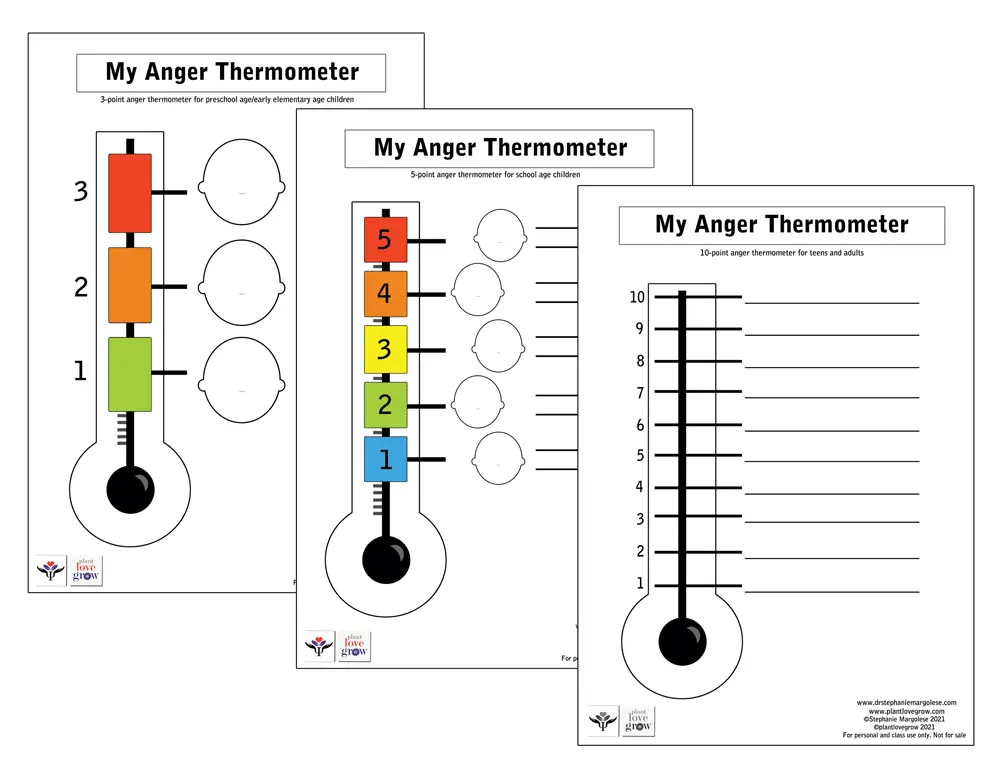
What is an anger thermometer?
An anger thermometer is essentially a tool that can be used with children, teenagers and adults to explore and learn about this challenging emotion. Just as one uses a thermometer to measure temperature, the thermometer serves as an indicator of the anger temperature or intensity of the feeling experienced within.
 In my clinical practice, I have seen a number of children and adolescents who suffer from Obsessive Compulsive Disorder (OCD). Here are different examples of how OCD presented in 3 of my clients:
  For example, she had to flush the toilet handle multiple times and repeatedly turn the faucet sink handles, turn the lights on and off repeatedly, check and re-check her hair iron to make sure it was off, do certain things an even number of times only, and perfectly align and order her clothes in her closet and in her drawers.
  Eating disorders (EDs) in children and adolescents are serious psychological conditions that cause changes in eating habits and can lead to serious or even life threatening health problems.
  With so much talk nowadays about food, diets, shape, and weight, it can be confusing as a parent to know how to help your child develop positive feelings about their body, no matter what size they are. Body image disturbances can begin as early as preschool, and can have lasting impacts. Why is it so important for children and teens to have a positive image of their body? Because young people with a positive body image are more self-confident in general and are less likely to develop eating disorders or weight-related problems such as obesity, or other emotional problems like anxiety or depression. While body image in children and teens is influenced by many different sources – including family, friends, and the media – parents play a pivotal role in helping to promote positive body image at an early age.
  It’s that time of the year already when summer has come to an end and the new school year is about to or has already begun. That means getting back into the daily routine and to busy schedules, back to studying, homework, and extra-curricular activities, back to traffic, long days at work, and seemingly endless household chores. Along with the change in routine from summer to fall comes shorter days, less time for fun and leisure, greater demands and deadlines to meet, and unfortunately, more stress (which can be both good and bad). Sometimes it may seem as if there is so much happening and at such a fast pace that one barely has a free moment to slow down and just BE.
  It seems to me that the term “depressed” is often loosely used to describe an intense feeling of sadness. Sometimes teenage clients will say “I feel depressed” to express that they feel down, blue, lonely, discouraged, disappointed, or very sad. While sadness is certainly a normal feeling generally experienced in response to some kind of loss or rejection, chronic feelings of sadness over an extended period of time (and often accompanied by other problems) can become a genuine concern. It is understandable then that parents, who see changes in their child’s mood and behaviour, may wonder whether their child or teenager can be suffering from depression. Indeed, children and teenagers can be diagnosed with depression (also known as a Major Depressive Disorder)
 In a previous post
  The teenage years have forever been characterized as a time of turmoil and change. It is during adolescence that youth are trying to discover who they are, where they belong, their likes and dislikes, and what they want for their futures. In order to exert their increased independence and to help prepare adolescents for adulthood, teens will pull away from their parents and move towards their peer groups. Indeed, the majority of the adolescents I have worked with are incredibly loyal to and protective of their friends (sometimes caring more about their buddies than about themselves).
  Teachers and school administrators often ask parents to have their child psychologically tested because of questions and concerns they have about a child in the classroom, such as distractibility, poor attention, behavioral problems, hyperactivity, learning difficulties, and social or emotional problems. While parents may also share similar concerns about their child, it can seem overwhelming for a parent to be asked to pursue formal psychological testing. Understandably, parents want to know what exactly does testing entail and whether it is necessary.
 In my clinical work with troubled teenagers, it is often the case that there is a real communication breakdown between these adolescents and their parents. These teens often feel that their parents do not understand or respect them, do not listen to what they have to say, and cannot relate to their experiences. They may report feeling isolated and closed off from their families, rejected, hurt, angry, anxious, sad, and lonely. In general, these adolescents have built up a “protective wall” between them and their parents (and sometimes the rest of the adult world) behind which they retreat. Because of problems with trust, these teens do not easily let their walls come down or let others see their vulnerabilities and insecurities.